Episode Transcript
[00:00:00] Speaker A: We're going to dive in now and open the word.
It's my privilege to open the word with you this morning.
Mark and Nita have been on holiday this last week and Mike is downstairs welcoming a whole bunch of students who are new in the city. And Des spoke last week and God, we keep scraping the barrel. So I've been churned out this week so we're going to have some fun.
Let's pray before we start.
Father, I ask that as we discuss topics from your word this morning, that it would be like those bread and fish, that even the little bit of thought provoking bread and fish that I bring this morning, that in the natural wouldn't be able to feed.
Father, that you take it, we all give thanks for it and you use it, multiply it, that it would be nourishment to every single person here. Father, we ask that you would speak to your people.
May I get out of the way? And anything I've planned to say that isn't necessary. And Father, may you speak that we would all leave here edified and encouraged.
In Jesus name, amen.
Amen. Fantastic.
Wonderful. Well, let's dive in.
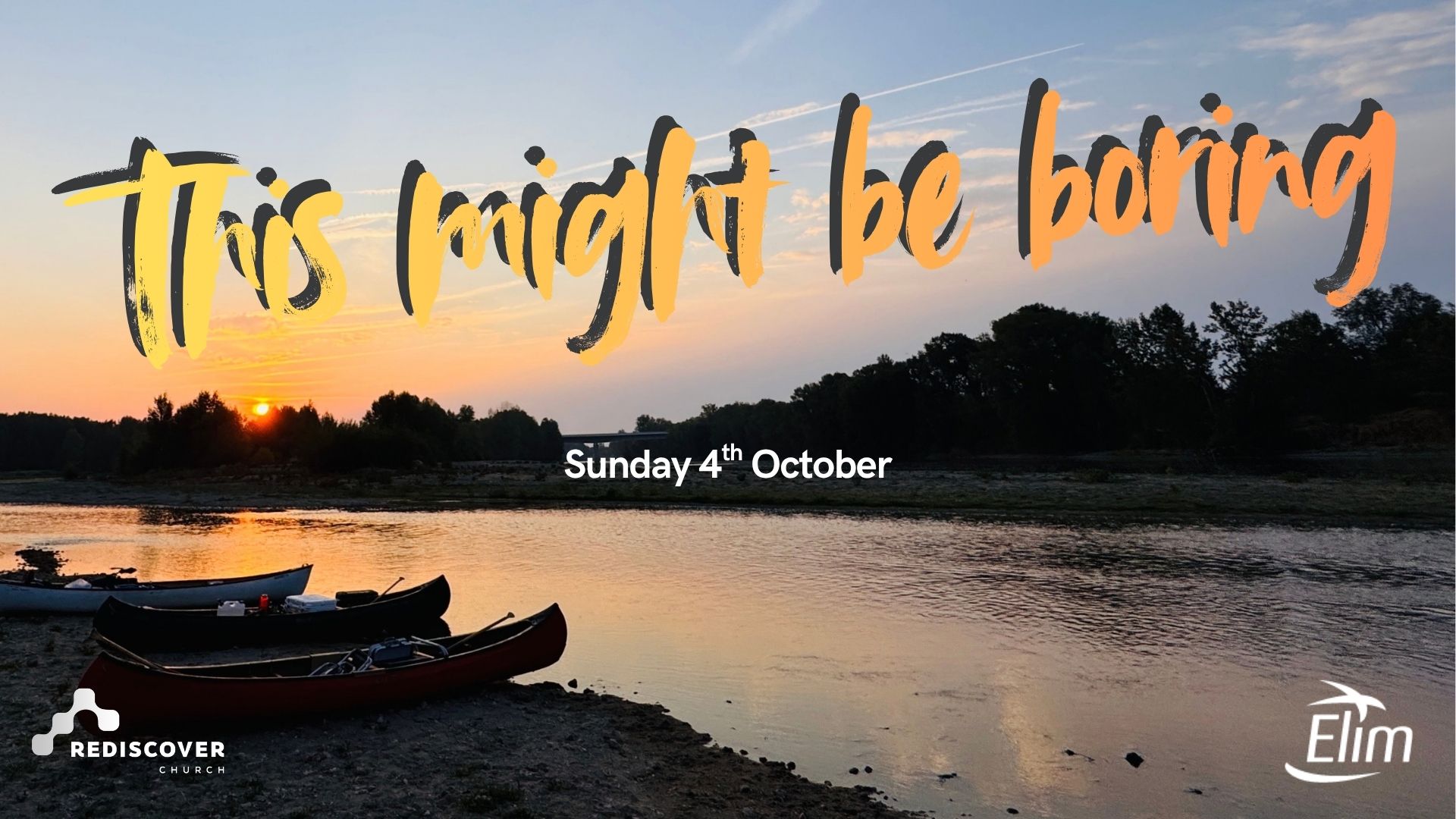
This might be boring.
It genuinely might be boring.
This picture here is a holiday snap from our recent holiday over in France. We've done this holiday a whole bunch of times. I've even probably talked about previous escapades. On this holiday, maybe several years ago, we go canoeing down the Loire river and go off the grid with another family, a lovely family from London that we know well. And this holiday, when we tell people about it, they always say, oh, it sounds amazing, sounds idyllic.
This is what we go to sleep to on a sandbar in the middle of the Loire river, canoeing maybe 200 miles down, wild camping every night. But the reality of that holiday is it's pretty repetitive.
You wake up every day, you unpack your tent, pack down your tent, you put it in the canoe, make sure everything's just about balanced and dry, you set off and you paddle for six, seven hours. You paddle and then halfway through you get lunch. And then at the end of it, you get your stuff out of the tent, out of the canoe, put up your tent, make a fire, cook your food, go to sleep because you're exhausted, because you've been paddling for seven hours. Then you wake up the next morning, get your breakfast, pack everything down again, put it in the canoe, set off again, paddle again. I love it, actually, because my brain has to turn off from all the things it normally is thinking about. My devices, all of our devices are in the bottom of the bag in a dry bag.
So I love the monotony of it.
In fact, the friends we go with this time he had a Garmin wristband and it told us at the end we did 201 miles and we paddled 44,000 paddle strokes.
That's a pretty boring holiday, isn't it?
Just dig, dig, dig the life we've been called to live. It's a few weeks ago Mark took three messages three Sundays to dive into our church.
Live, love, thrive.
I'm going to talk a little bit about that and also about what lies underneath them.
Because those values are not just our church values that we put on our website. They're not something that a few people who are doing some element of leadership in this church want to aspire to. It's something that we all want to grab hold of because we are the church. It's not this building, it's not two or three people who are employed.
In fact, a few Sundays ago, Mark asked all of us that wanted to join with the team, to be part of that team to stand. And we had people all across the room, pretty much every single person standing, to commit themselves to not just be in a church where other people ministered, but to do the work of the ministry for all of us to be part of that, to all of us to reach for those live, love, thrive values. Let's just quickly have a look at them.
Live courageously.
There's a whole bunch of other words under these that we can dive into. We won't today, but you can look at them on our website if you'd like to. I encourage you to underlive courageously. I love this one. Stewards, not owners.
Everything we have and every opportunity is entrusted to us for serving his purpose, not ours.
Faith filled.
We innovate. We take kingdom minded risks and refuse to settle knowing there are many more God inspired adventures ahead.
So live courageously. We have got love extravagantly. We will love God with everything. Welcome everyone. Demonstrate grace.
Be generous, scatter and gather. We mean by that to be expressions of God's radical love in every sphere of influence which opens up to us daily.
And then we've got thrive authentically. Live love, thrive.
Commission each other. Become. Worship sincerely. Communicate effectively. Be a family. By be a family, we mean cheering one another into God's purposes for our lives, showing grace and hope when we fail and sharing in the joy when we succeed.
This is the church we want to be.
It's certainly not what we Always are.
It's aspirational.
But we want to live big lives.
We want to love people extravagantly, to take risks, to bring hope, to make a difference, to believe that God can do extraordinary things through ordinary people.
It's not a vision for sitting on the sidelines.
It's adventurous, courageous, expectant.
Although I do sometimes wonder if some of us look at it and think it's a little bit ambitious, a little bit overwhelming.
So in light of these values, I want to ask you what might be a slightly uncomfortable question this morning.
Are you boring?
In fact, let's make this real. Turn to the person next to you, look them in the eye and with all sincerity say, are you boring?
You don't have to answer. You don't have to answer.
A few people are studiously avoiding responding to that one.
Okay, okay, okay.
Not Are you a bad person? Are you unsuccessful? Not unhappy?
I don't think we want boring careers, do we?
Boring families, boring marriages, boring weekends. Certainly not boring Instagram accounts.
We want stories, experiences, progress, recognition, something happening. I think we increasingly live in a world where ordinary feels like a failure.
Perhaps some of us are feeling that it's a bit boring to be back in this old church building after our adventure at Pop up, when we thought we might be in a new one.
I'm going to bring up on screen a picture. Here it is. Who knows what building this is and where it is.
It's the Burj Khalifa. Indeed, in Dubai.
Beautiful building. One of the most interesting buildings I've ever been in. I was there on work a few months ago and I had a couple of hours gap between meetings and I thought, why not?
This is an incredible building.
828 meters high. Can you imagine that?
So you can see it when the sky is clear. You can see it 59 miles away. So Maldwin and his wife came from Plymouth.
That would be the same distance. Good cheer for Plymouth there. Thank you.
But that means if this building was in Exeter, here you'd be able to see it from Plymouth. When you started driving, that's how tall it is.
110,000 tons of concrete to make this thing.
It's pretty incredible. Going up, it go up to about 124th floor, I think is the viewing gallery and you look out and you're just triple the height of everything else around you.
Those lifts go up at like 10 meters a second. You can get to the entire top in a minute.
Makes your stomach wobble slightly.
It's even designed around a desert flower just the shape of it to be wind resistant. It's fascinating. And they've got this whole journey you can go on, where you go through this process of seeing how it was built and see the design, structure and the architecture, and it's really quite interesting. I'm not that into architecture, but I can really respect the massive amount of work that went into this. Millions and millions of person hours over the course of six years.
But if I was to ask myself, what's the most interesting part of this building?
It probably would be that design, it would be that height, that scale.
But I want to talk today about the least interesting part, the first part of that journey. You go on in the first couple of floors through this tourist exhibition, if you like. It just talks about digging the foundations, and the foundations are the least interesting part of this building. They're 191 rods that go down 50 meters through the desert sand and into solid rock that's underneath. There's huge desert winds that come through this area.
So a huge amount of time was spent going deeper before they started building. But it's pretty boring.
No one visits London and says, I want to take a picture of the foundations of the Shard.
No one posts them. You can't even see them.
So when I ask you this morning, are you boring? I'm actually not asking at all about whether you're interesting or not, but are you boring?
Are you going down deep?
We finish there, can't we?
We're going to talk today. Not are you deeply boring, but are you boring deeply?
Are you digging beneath the visible surface of your life?
Jesus tells this story about two people and they were building something that looked remarkably similar above the ground.
But the difference was that someone dug deep.
We've confused visible progress with real progress.
Depth in the here and now often just looks like delay.
If we load on screen, let's look at Luke 6. If you've got a Bible with you, feel free to open it. Luke 6, 47, 48.
The context here is the sermon on the plain. The whole passage of Luke 6 talks about it and it inverts what we would see as normal.
In verse 20 through 26, it's the Beatitudes, blessing the poor, the hungry, the weeping while warning the rich and the self satisfied.
Verse 27, Love for enemies, doing good to those who hate you, Blessing, blessing those who curse you, lending without expecting repayment.
Verse 37 onwards, warning against hypocrisy.
And then verse 43, explaining that a good tree produces good fruit, that your spoken words and actions actually reveal what's under the surface.
And so we see and hear Jesus expound on all of these counter cultural non intuitive topics. And Then in Luke 6:46 before this scripture comes, he says why do you call me Lord, Lord and do not do what I say.
Let's read this together.
As for everyone who comes to me and hears my words and puts them into practice, I will show you what they are like.
They are like a man building a house who dug down deep and laid the foundation on rock.
When the flood came, the torrent struck that house but could not shake it because it was well built.
And of course the verses after this go into what happens when you don't have deep foundations forever. For everyone who comes to me, hears my word and puts them into practice, I will show you what they are like. Like a man building a house who dug down deep.
The context of this passage establishes that Jesus demanding ethic of love and mercy and humility without putting it into practice leaves people exposed, leaves us exposed, leaves me exposed to all of life's storms. Imagine these two neighbors. You've got one over here who's starting building.
And then neighbor B over here is starting building. And day one, we're starting to lay bricks. We can see some visible progress. Day one, that's just a spade.
Day two, we're now starting to build up those walls, maybe put in some windows. There's just a hole in the ground. Day three, maybe we've got to the roof, we're doing some trimmings.
Neighbor B has maybe hit rock and so needs to go and get some form of bigger digger to get through what's underneath.
Who looks successful?
Neighbor A is saying, just check out what I'm working on posting on their social accounts. And Neighbor B is just standing next to a big muddy hole.
Who looks successful?
Luke 6 says, you don't discover who built wisely while they're building. You discover it when the flood comes.
There are seasons of life where shallow and deep look exactly the same.
Then there are seasons of life where they look really different.
Both careers are working, both marriages look fine, both families are functioning, both people are singing on Sunday.
And then the water rises.
How much of my life is spent building things that people can't see?
We sing that song, Rain came, wind blew, but my house was built on you.
Are you boring?
Some people in our congregation here work on construction sites. You might be a tradesperson or an architect, a builder.
You know the reality. Particularly in Devon, where it just loves to rain a lot. Building sites are messy. They're Chaotic, they're muddy.
It's often not pretty. We used to live in Pinho and those of you who've lived in that area of the city, although many areas of of the city have done the same thing. There are thousands of houses being put up and when the whole community is built, it looks gorgeous.
They've done a good job. Many of us live in those new communities, but in the first couple of years of what's going on, it doesn't look good at all. There's red dust everywhere, there's mud everywhere, all the roads are caked with it from all the trucks coming in and out. And all you can see is a hole that gets deeper and deeper and deeper and then huge amounts of concrete that get poured.
That's what boring looks like.
It's hidden, it's repetitive and it's hard.
It's actually the opposite of what we want in our lives often, which is attention, novelty and ease.
So boring. The type we're going to be talking a bit about today is dark, hard, and you've just got to keep on going.
We're going to talk about those three elements of digging, of going deep, of boring, that it's hidden, that it's repetitive, and that it's hard. Firstly, it's hidden.
We crave attention, but God does some of his deepest work in obscurity. We live in an age where visibility has been confused with significance all around us. We see follower counts, we see engagement metrics, we see influencer careers, popularity contests.
I have to challenge myself with this.
Where in my work do I have that need for recognition and significance rather than just serving those around me?
If nobody knows I'm doing it, does it still count?
If nobody congratulates me for serving, do I keep serving?
If nobody sees my generosity, am I still generous?
If my obedience doesn't create a story I can then tell others about, is it really obedience? Enough foundations just don't get applause. No one walks past that building site and stops and applauds those who are at that stage of building. It's buried. The foundations are buried. But remove them and everything else disappears.
Think about Jesus life. 30 years in relative obscurity before those final few years where the world was transformed.
What are you willing to build that no one else will ever see?
Prayer when nobody knows.
Integrity when no one else would find out.
Serving without recognition, generosity without acknowledgement.
Matthew 6 says a bit about this hiddenness, and I've just summarized it here for speed, but it talks about not practicing righteousness to be seen by others.
Not giving by announcing it with trumpets.
Don't be like the hypocrites because they love to stand praying in the synagogues, in the street corners. But go to your room, close the door and pray to your father who is unseen, and then your father, who sees what is done in secret will reward you.
There are beautiful people all across this congregation that inspire me in this sometimes because I help out with a few different teams. You just come across little glimpses and glimmers of stuff that people are doing behind the scenes, not for applause and not for congratulations. You just hear that. So and so took a few people out for coffee because they were known to be lonely and wanted to befriend them. Or so and so went and cleaned the garden because that congregation member wasn't able to. Or so and so just stepped in and helped pay for something because there was a need.
You just hear glimmers of it. It's probably just a 1% of what actually is going on. But I get so inspired when I hear those stories.
So much of what God is doing through you is unseen.
But God sees. Hidden, isn't wasted. Hidden is where the foundations are built. I truly believe that the foundations of our church aren't built.
We can describe some values and all gather together and put the lights on and worship there.
The foundation of this church is all that unseen work that happens, all of those relationships that are built. All of you who lean in day after day, week after week to help those that are around you.
Last week, Norman and Al Gibson gave a really powerful word about paying attention to those who are hurting and in mourning, releasing the captives, bringing light to those who are in darkness.
I also believe there's hidden areas of our society, perhaps things we've not chosen to focus on for our own convenience.
So God, please help us only seek your recognition and open our eyes to those around us who are truly in darkness or hidden.
Secondly, digging is repetitive.
Just like those paddle strokes on the Loire River, 44,000 times. Digging that paddle into the water, pulling ourselves along.
Digging's repetitive. We crave novelty.
I crave novelty often. I like variety. I like going to different restaurants and going to different places, experiencing different things.
But God forms us through consistency. Digging is incredibly boring.
I've only had to do it a few times. We've got a garden where sometimes I've been dragged kicking and screaming. Some of you are great gardeners. I'm not a great gardener. I don't have green fingers.
And that process of digging in. Lift dirt out again. Lift dirt out Lift dirt out.
Sometimes we watch these documentaries. We as a family love to watch adventure documentaries, travel documentaries.
But having been on that trip down the river in France several times, I know that the highlight reel will be really short.
We see these people traveling down the Amazon or the Nile and they skip out the constant monotonous travel.
Just give us the highlight reels.
And that's part of the problem, isn't it? We want transformational to feel transformational, but it feels repetitive as it's building.
Think about almost everything that transforms you.
Think about your body. One workout isn't transformative.
One healthy meal isn't transformative.
One conversation doesn't make a marriage.
One prayer doesn't make a prayer life. One act of giving doesn't make you generous.
One Sunday doesn't build faith.
But it's the same apparently insignificant action repeated over time that compounds. So we've got to fall in love with consistency.
We've got to fall in love with sameness.
Galatians 6, 9 says this so well.
Let us not be weary in doing good, for at the proper time we will reap a harvest if we don't give up.
Why would Paul have to say that?
Because even doing good can get boring.
Not because goodness is boring, but because when you're doing something repeatedly, faithfulness often just stops feeling exciting.
I think sometimes our appetite for novelty can be really dangerous in this regard. Maybe I need a new job, a new practice, a new calling, a new diet, a new church. Sometimes you do, but sometimes you don't need a new thing. You just need a new faithfulness to the old thing.
Because faithfulness compounds.
What have you stopped doing simply because it stopped being exciting?
And the third thing here is that digging is hard.
We crave ease, but God forms us through resistance.
We crave efficiency, just getting something done. But God's often much more concerned about the process rather than the outcome.
I think we are right now in an age where this ease is being turbocharged. With the massive superficial adoption of generative AI with us, everyone's using AI tools to do everything.
We all face it, many of us in our own work. Getting to the solution is really easy now.
Machines made things easier for our bodies. Tv, social media made things easier for our relationships and our sense of connectedness.
AI makes things much easier for our minds.
But what do we lose when we no longer have to wrestle with the how.
How to write that sentence? Well, what the answer really is. What I need to remember that I forgot yesterday.
I think things are getting easier than ever for our minds. And it's a generational crisis kind of waiting to happen. Because resistance is valuable for our minds.
I truly believe that church gathered like we are this morning is one of the great remedies or antidotes for that. It's not easy.
Relationships aren't easy. There's friction, there's disagreement, there's stuff you don't like about me and that's okay.
We turn our phones off for a bit. We wrestle with hard and often unanswered questions.
It's beautiful.
I work in tech and so we work alongside some of the biggest frontier AI companies and it's incredible to see what this is doing to our lives.
I love that some schools now are actively working against this. We got a great email from my kids local school out in Ottery last week talking about how now all the phones are going to be in pouches for the entire school day. Locked pouches.
I think that's beautiful.
I really do.
And I also loved how they described why they were doing said we want to give students the space to think deeply and engage meaningfully.
This is hard. It's so easy to say, what's the answer. I get confronted with this daily as a parent. Those of you who are parents here, you know your kids ask why many times.
And as they get a little bit older, Danny and Elliot are now 12 and 14, the questions become harder.
When they were five years younger, it was easy. You could just bat away the questions. You could make something up or could answer the correct thing because you knew what it was. But now they're deeper, harder questions. And the problem is the bias with me would be because it's what I would do in my workplace. Just go to ChatGPT and type it in and give them the answer. But what are we teaching our kids, right? If that's our process of wrestling with difficult questions.
Resistance, friction isn't evidence that you're digging in the wrong place.
It may be actually evidence that you're digging in the right place.
We've built a culture about friction removal.
Easier, faster, instant, seamless. One click.
Amazon, one click. Delivery Claude AI generated code delivered tomorrow. I think there's a spiritual danger that sits underneath that because we therefore kind of interpret friction as failure.
This relationship is difficult.
This season is difficult. Prayer feels difficult.
Forgiving them is difficult.
Serving these people is difficult.
With the kind of assumption being, therefore I should escape it. But scripture repeatedly presents resistance as formative.
Many of us will know that scripture in James 1, James 1, 2, 4. Consider it pure joy.
My brothers and sisters, whenever you face trials of many kinds because you know that the testing of your faith produces perseverance. Let perseverance finish its work so you may be mature and complete, lacking nothing. Trials lead to perseverance, lead to maturity.
The thing we naturally ask God to remove may sometimes be the very thing God's using us to form.
And please hear me. I'm not saying that we should always remain in suffering. Sometimes getting out is the wise thing to do.
I'm not saying you should manufacture hardship.
But we should challenge the assumption that easy is God's will and hard is the wrong direction.
You don't develop patience without waiting.
You don't develop courage without feeling fear, but stepping out. You don't develop perseverance without wanting to quit along the journey.
You don't develop forgiveness without being wronged.
You don't develop faith without deep uncertainty.
What are you currently trying to escape that God might be inviting you to go through?
Hidden, repetitive, hard.
It doesn't sound like a compelling vision for your life, does it? Doesn't sound like a church bumper sticker we could put up. How about this? Come to church, we've got a vision for you. You might not be noticed. You'll do the same thing repeatedly each week and your life will probably be difficult.
But what if those things aren't bugs, but features?
What if that's how foundations are built? Hardness forms character. Consistency forms faithfulness. Resistance forms strength.
So this morning I want us just to genuinely consider. Are you boring?
Those spectacular, exuberant, well defined values that we opened with at the start, they aren't produced by chasing spectacular lives.
Because the life that everybody sees, your life that people see, it's sustained by the life that nobody sees.
Live, love, thrive, Live courageously, love extravagantly, thrive authentically.
But underneath, hiddenness, consistency, resistance, perseverance, just keeping on.
We say we want to be people of extraordinary faith, but that's not built on a stage. It's built on hundreds of really ordinary moments where nobody sees you choosing to trust God on the Monday morning. That's hiddenness.
We want to be radically generous.
That's not an emotional response to one inspiring message on a Sunday, to one big ask.
It's becoming the kind of person who time and time again just gives consistently.
We say we want to love God with everything that sounds exciting on the wall, but living it out will cost you something when it's inconvenient or uncomfortable or painful.
That's resistance. In Luke 6, Jesus talks about these two people who are building and from the curb it might have looked exactly the same.
But the difference is underground.
Live, love, thrive. But underground?
Are you boring?
Not chasing attention, not looking for something new, not structuring your life around something that's easiest.
It's built when no one's watching. When you're doing the same thing again for the thousandth time. I realized just now when Maldwin was speaking, I thought, I wonder how long I've been in this church. And I did it. It's over a thousand Sundays. How cool is that?
There's people here who've been there longer than me. But this stuff compounds. Does it mean that every Sunday is this top of the mountain experience? We're all high fiving each other and walking out the door feeling like we're on a different spiritual plane? No, a lot of those are just really hard.
Getting in early. There's people all across this congregation that come in an hour before anyone else does. Cleaning, tidying, setting up, getting children's church ready, making sure the sound's working, fixing bugs in the computer system.
The extraordinary life that we all want is built through remarkably ordinary faithfulness in that scripture. In Luke 6, Jesus finishes with this challenge. And I want to finish with it too.
Both of these men heard.
That's important because everyone today has heard.
But the difference wasn't hearing, it was doing.
So what do we do in response? Maybe the worship team could just join me.
Let's just consider what we can do this week.
Hiddenness.
What will you do even if no one notices?
Just ask yourself that this week. What am I going to do even if no one ever finds out?
Consistency.
What are you going to keep doing?
Although you've been tempted to give up, perhaps it's not exciting anymore.
Resistance.
What hard thing are you going to stop running from?
Maybe saying sorry to that person or forgiving that person is the hard thing that comes on your mind. And rather than letting it fall down the priority list this week, you're going to grab hold of it and do the hard thing.
I really hope we're a church who are full of boring people.
Boring past the attention, boring deep past the novelty, boring through the resistance, boring down deep until our lives hit solid rock.
Because that's where this kind of life is built.
Let's just bow our heads and pray.
Father, as we've read your word in Luke 6, We want to be people who don't just hear, but do.
Father. Bring to mind Holy Spirit. Bring to mind people. Things that we need to pick up as we walk out of this.
[00:33:56] Speaker B: Building
[00:33:58] Speaker A: conversations that are difficult but we need to go towards habits that need to be formed. But just start by Monday morning starting on a different footing.
Shortcuts that we built into our life that we now need to kind of delete.
And embrace the heart.
Bring those things to mind in Jesus mighty name.
If God's called you to be a shepherd, just keep caring for those around you.
Don't be weary in doing good.
The evangelist keep finding those opportunities even if there's been a thousand no's, Those with a prophetic edge.
Keep calling out in other people what God has in them and for them.
Teachers. Even when it feels like your words are just being ignored, keep on helping, instructing guiding apostles those who carry something new.
Don't give up. Don't despise the day of small beginnings. That project you started.
Trust for the next step.
No one else can do the job that God's got for you as well as you can.
I also think there's a portion of people who are in this church who aren't seeking in any way to do the extraordinary.
And you're disqualifying yourself from continuing to do what you think is ordinary because you think others can do it better than you or because you think it doesn't count or it doesn't matter.
But we need those things you're graced for.
Don't disqualify yourself.
Just keep on showing up.
What you find easy, others find hard what you gravitate towards others. Miss.
Keep on keeping on.
Just while you're having that conversation with God, let's just sing that refrain.
[00:36:49] Speaker B: I am safe with you I'm gonna make it through the rain came and the wind it blew but my house was built on you and I safe with you I'm gonna make it through the rain came and the wind blew but my house was built on you and I'm safe with you yes I'm gonna make it through I'm gonna make make it through Cuz I'm standing strong on you I'm going to make it through Cuz my house is built on you I'm going to make it through Cuz my house is built on you I'm going to make it through Cuz my house my house is built on you Sing woe.
I'm gonna make it through oh.
My house is built on you Christ is my firm foundation he's the rock on which I stand when everything around be shaken oh I've never been more blind that I put my faith in Jesus Cuz he has never let me down He's Faithful through generations.
So why would he failed now?
He won't.
He won't.
He won't fail.
He won't fail.
He won't.
[00:39:36] Speaker A: He won't.
Father, thank you.
That every single person here would feel that solid rock underneath their feet.
If you haven't found that solid rock yet, if you want to make a commitment to place Jesus at the very center of your life, we'd love to pray with you. Maybe after we just finish in a moment, just come down to the front row and a couple of us would love to pray with you.
What's the subterranean work you need to do this week?
What's the underground, hidden, hard, boring stuff that you've got to do this week?
A few months ago, I was invited to say a few words at the funeral celebration of life for John Parker, who was my headmaster at school when I was young and one of his favorite scriptures was Psalm 1.
I was able just to open that and remind everybody who came to celebrate his life that he constantly would ask us to memorize that beautiful psalm. Blessed is the man doesn't walk in it, doesn't counsel of the wicked or stand in the way of sinners or sit in the seat of mockers. But his delight is on the law of the Lord. And on that law he meditates day and night like a tree planted by streams of water, yields its fruit in season.
Leaf does not wither. Whatever he does prospers.
It was one of those beautiful celebrations of life because everyone there recognized God in him, the foundations that his life was built on, the rock that the roots of his life was laid on.
Father, I ask that we would be like that tree as we leave this place, as we run into our next week. Father, help us embrace the boring, the hard, the hidden, the difficult things. This week in Jesus mighty name, all God's people said amen.