Episode Transcript
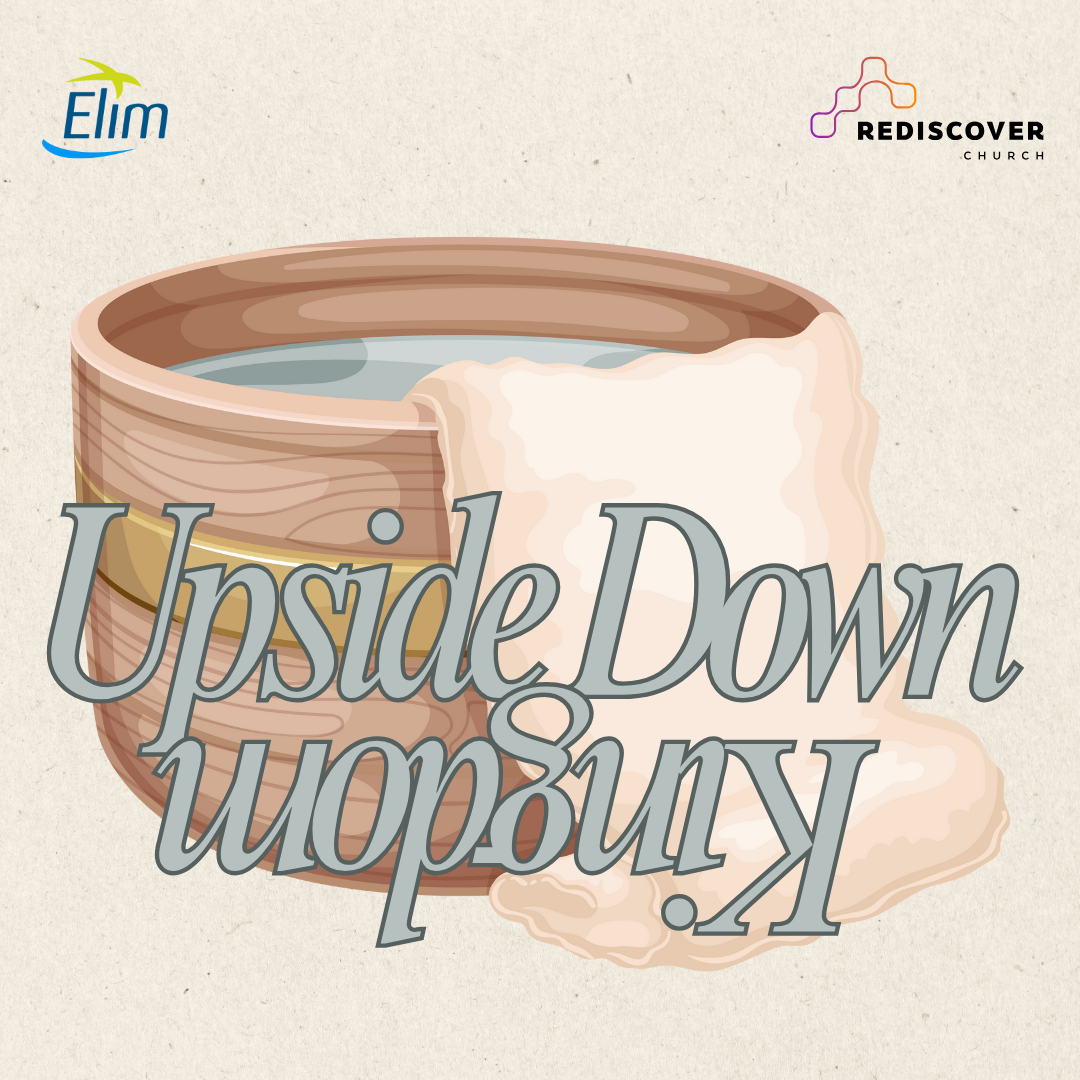
[00:00:03] Well, this morning it's a real privilege to be able to bring a message talking about the upside down kingdom and the power of the towel. Let me explain.
[00:00:13] As Jesus was sharing his last meal with his disciples, there was a moment where he taught a lesson that the disciples were not ready to hear or to learn.
[00:00:25] In the middle of the meal, the Bible says he got up from the meal, took off his outer clothing and wrapped a towel around his waist.
[00:00:34] John 13:4. In one of the most strange and countercultural examples Jesus gave to his disciples, he shocked them by washing their feet. He put a towel around his waist and, and began to wash the mud, the grime, the animal excrement, everything that the disciples would have walked upon that day in their open sandals. And Jesus proceeds to wash their feet. Now, I don't know if any of you have watched, the chosen have been following along, but there's a scene, and it shows Jesus washing the feet of the disciples. And they could not handle it. They did not know what, what to do with Jesus, their rabbi, washing their feet.
[00:01:22] This example in John 13 wasn't about hygiene.
[00:01:25] This was not a hygiene lesson that Jesus was teaching his disciples. It was about humility.
[00:01:31] It was about identity.
[00:01:33] It was about community.
[00:01:35] Jesus, knowing all power had been given to him, was choosing not to use that power to lord over, but to choose to serve. He redefines what it means to be great, and he reveals what it means to belong to a kingdom that God is establishing.
[00:01:53] And Jesus came to shake up what culture perceived to be right.
[00:01:58] Jesus flipped the world system on its head and said, this is a different way to live, and I want you to live this way. And this act of service was a catalyst for the church that was birthed after Jesus was crucified and raised to life.
[00:02:16] Teaching an upside down kingdom, going against the culture of the world. And there's a few things that we see that this began within the disciples. And the first progression or the first step that these disciples were being encouraged to take was to move from serving self to serving one another, from serving self to serving one another. When Jesus knelt to wash the feet of his disciples, it was the job that should have been reserved for probably the lowest servant in the house.
[00:02:48] So culture and tradition of that day says a person who gets paid the least or not paid at all, the person who would be considered the least in the household was the one that should do that dirty job.
[00:02:59] And so when Jesus begins to wash the feet of his disciples, they were concerned because that's not how it's done.
[00:03:08] How many people know that Jesus wasn't really concerned about those kind of thoughts? That's not how it's done.
[00:03:15] How many people are so thankful that God took a look at your life and my life and said, bit of a mess, but let me help clean it up. Let me bring my word and truth and let me bring a.
[00:03:32] How many people are so thankful that Jesus washed their feet?
[00:03:36] And as Peter said, not just my feet, but everything.
[00:03:39] God has done that work in our lives, hasn't he?
[00:03:43] John 13, 14, 15.
[00:03:45] He said, now that I, your Lord and teacher, have washed your feet, you should also wash one another's feet. And just in case you're wondering, I'm not doing a foot washing ceremony at the end of today.
[00:03:57] Been done before, but it's not happening today. Just in case you're worrying if you should have put on an extra pair of socks, it's okay.
[00:04:05] But Jesus, he stooped to serve.
[00:04:08] Not because he was weak, but because he wanted to show the power of love.
[00:04:14] And here's a challenge that we have.
[00:04:17] We live, I think, under the pressure to have it all together.
[00:04:21] Does anyone feel that pressure?
[00:04:23] Sometimes you gotta walk in, whether it's been a parent, a boss, an employee, and you feel the sense of pressure to have it all together.
[00:04:36] I feel it.
[00:04:37] I feel it. To feel like I've got everything together. Well, this is a really horrible day to preach this message. Cause I don't have it all together today.
[00:04:46] There's some stuff that's going on in my life. I'm so thankful for friends that stood beside me today. As I'm going, I'm struggling to let some of these burdens go, giving them to God. But you know, I'm still holding some of it.
[00:05:00] And the prayer of God, thank you for Mike. I got friends, I got people in my life that would get alongside me even as I'm going to preach on this. And now I've got to live it as well. I hate it when he does that to me, but I love it because this is what we signed up for, a heart to serve others.
[00:05:23] I think we're afraid that someone might think we're weak.
[00:05:28] Maybe somebody thinks our life's a bit of a mess, that we're not strong enough.
[00:05:36] I've discovered in the last 12 months of being here, it is a little bit of a British thing, stiff upper lip and all.
[00:05:46] Yeah, you've had to fight the whole world for centuries and hold our ground, but actually that stiff upper lip, that sense of strength and having it all together is Not a strength.
[00:06:09] It's probably a weakness.
[00:06:11] Now, I do love this church because I don't think that is representative of what this church is.
[00:06:17] I love the fact that this is a church.
[00:06:20] We get real. We talk about the things that need to be talked about.
[00:06:24] I don't think we ever pass ourselves off as being perfect or having it all together. I hope you would never feel that or sense that when anybody gets up and shares or leads, that there would be this impression that we've got it all together because. But by the grace of God, we don't stand a chance.
[00:06:41] But I think we can sometimes be tempted to put up a mask of spiritual perfection.
[00:06:47] I had to put that mask away this morning because I walked in, Amy, and I walked in going, I don't know if I want to do this today.
[00:06:55] That's the honest reality. I was walking from the car park here going, well, I'd like to walk away today.
[00:07:02] I really would.
[00:07:03] I'd like to just go home and not talk to anybody today.
[00:07:07] That's the reality of my world today.
[00:07:09] And I'm okay to admit that.
[00:07:11] I'm okay to put that mask of perfection or whatever it is, or, I've got it all together. I don't have it all together.
[00:07:19] I know God does, but I'm human.
[00:07:22] I struggle to let go of some of those things. Sometimes I struggle with the things that I feel like I want to control or need to control. And. And God says, I've got this. Will you trust me?
[00:07:34] Sometimes we struggle to receive kindness, generosity.
[00:07:39] Why? Because maybe we might have to owe someone something in return.
[00:07:44] See, pride kicks in when all of a sudden we think that if somebody blesses me with kindness, generosity, maybe offers you a coffee or something like that, you go, well, I better pay you back.
[00:07:59] No, they're just being generous.
[00:08:02] I was taught a very valuable lesson probably 20 years ago.
[00:08:06] Remember, somebody wanted to bless us with something, and it was beyond what I thought they should bless us with. I said, no, no, no, I just can't receive it.
[00:08:13] No, that's too much. You just don't. No, no.
[00:08:18] And I remember walking away from that conversation, just that gentle nudge of the Holy Spirit, almost as though God was saying, so you won't receive my blessing.
[00:08:33] I asked that person to bless you, and you wouldn't receive it.
[00:08:40] That was a real lesson in humility there.
[00:08:44] Because here I was thinking, well, I'm going to have to pay them back an equal portion.
[00:08:50] No, Jesus is saying, here, I want you to serve others.
[00:08:58] See, the towel teaches us a Different posture. Authentic humility says, I don't have it all together.
[00:09:04] That's why I need you and you need me.
[00:09:10] How do we apply this to our day to day?
[00:09:13] Let someone wash your feet.
[00:09:16] Maybe not literally, but hey, maybe, but allow people into your world to bless you.
[00:09:25] Receive a blessing if somebody offers it and just say thank you.
[00:09:29] Now, what you do with that blessing is entirely up to you and God.
[00:09:33] I remember it wasn't long after we arrived, I heard of a need of somebody that needed something and it was a particular amount of cash, and I didn't have it on me. I said, God, I'd really love to meet that need. And somebody came and said, I've got a blessing. I just want to bless you with this gift. It was a card, a lovely card. And in it was the exact amount of money I needed to bless this other person.
[00:10:01] So I thanked that person.
[00:10:03] Yeah, give God some praise for that.
[00:10:06] So I thanked that person for, for their blessing and their generosity, and then I proceeded to give that blessing to someone else.
[00:10:18] Now, this is the power. This is where we're getting to in this message is I didn't have the means, but we did.
[00:10:27] This is the power of the towel.
[00:10:30] This is where Jesus was taking them. Second thought this morning is that God wants to move us from dependence to interdependence.
[00:10:40] Not independence, but interdependence.
[00:10:45] Hebrews 5, 12, 14. It says, by this time you ought to be teachers. You need someone to teach you. But solid food is for the mature.
[00:10:52] Peter calls us to crave spiritual milk in 1 Peter 2, but not to remain infants.
[00:10:59] Maturity says we are moving forward. Maturity says we are growing. We are developing from being spoon fed to maybe feeding others.
[00:11:09] From passivity to an ownership, a sense that we are owning this together.
[00:11:14] And every believer starts dependent. We do.
[00:11:19] We need someone else very often in the beginning.
[00:11:24] My children, our children, they need us still.
[00:11:29] They really needed us right at the start. Great, you're born.
[00:11:34] Enjoy life on your own.
[00:11:37] Not a chance.
[00:11:39] They wanted to be fed. They wanted nappies changed.
[00:11:44] What a nightmare.
[00:11:46] Yeah.
[00:11:48] Now the great thing is in the morning when we wake up, Amy makes me a coffee or I make her a coffee. And that's all we have to do to start our day.
[00:11:59] Our children feed themselves, they get changed, they make their own lunch and they get out the door because they don't want to be late for school.
[00:12:06] We don't have to drag them or force them or push them. They're growing up.
[00:12:11] Are they okay on their own? If I left them to it?
[00:12:15] Not yet.
[00:12:17] Are they still dependent? Yes, they are.
[00:12:21] And I always thought my goal as a parent was to teach my children to be independent.
[00:12:28] I realized I was believing a lie of society.
[00:12:35] Hold on, don't we want our kids to be independent?
[00:12:37] Actually, I don't see anything in scripture that speaks of independence.
[00:12:44] Because independence in very nature is to be free from control, influence or support of others. It means to be self reliant, not needing anyone else.
[00:12:57] I don't want my children to be independent. I want them to be responsible. Yes, but I want them to learn to be interdependent.
[00:13:07] My goal is not independence for my children.
[00:13:10] My goal is for them to get to that place where they could be dependent.
[00:13:14] But they move very quickly from that place of dependence to independence to say, I need others in my life and I need to be in the lives of others.
[00:13:28] That is where we start to see some very exciting things take place in the church community.
[00:13:36] I take discipling my own children very seriously and it matters to me and it's important.
[00:13:42] But I also recognize that there are significant others in my children's lives that I know they need.
[00:13:50] My girls need some young woman and older women in their life to speak life, to disciple them to be in their journey. I need my son that my voice is not the only voice that he hears. I want him to hear other male voices speak into his life to say, you can, you've got what it takes. Well, you know what? You're out of line. Sort it out.
[00:14:11] We need that.
[00:14:12] I want that for my children.
[00:14:14] 1 Corinthians 12:21. The eye cannot say to the hand, I don't need you.
[00:14:18] That's independence. Independence says, I'm fine, I've got this together.
[00:14:23] Guess what? You don't, you won't.
[00:14:28] We're just not built to be independent. God built us in Christian community to be interdependent. We're never meant to do this journey alone.
[00:14:38] And so Jesus foot washing wasn't about personal humility. It was about forming a brand new kind of community.
[00:14:45] And this is the challenge as I've said it. We prize rugged individualism.
[00:14:49] You know, that self made man.
[00:14:52] If I can do all of this, look at what I've done. Look what I have achieved.
[00:14:57] The famous words of Uncle Frank, I did it my way.
[00:15:03] And, and that's the cry of our generation, I did it my way. Look at what I've done, look at what I've created. I'll tell you what is far more exciting is look what we did.
[00:15:15] Look what With God in the middle, Holy Spirit inspired community. Look what we did together.
[00:15:22] That's my goal, that's my dream. That's what I want my family to be a part of. Is that inter dependence.
[00:15:33] Let's read from Acts chapter two.
[00:15:36] So the story progresses. I'll do a very short progression from there to there.
[00:15:42] But Jesus, he had his last supper. He went into the garden. He was taken before the court.
[00:15:48] He was falsely accused of crimes that he didn't commit.
[00:15:51] He was crucified on a cross, buried for three days. He was buried.
[00:15:58] Then he was raised to life again through the power of God.
[00:16:02] We celebrated that through communion this morning.
[00:16:05] And then there's a moment where Jesus says, I'm going to be returning to my father appeared back to the disciples and says, you will receive power when the Holy Spirit has come upon you. But I want you to go wait in Jerusalem until that happens.
[00:16:18] And so there's this incredible moment where a group of people sat waiting.
[00:16:26] Now we have the luxury of knowing the story, right?
[00:16:30] It's easy to look at it and go, fantastic. Jesus said, wait. He didn't say, go wait 50 days. He didn't give any time frame. He just said, go to Jerusalem and wait. And the Holy Spirit will come and you'll receive power. And that power will enable you to be a witness everywhere to the ends of the earth.
[00:16:53] Acts 2:1 4.
[00:16:56] See if you can see some key phrases from what I've been talking about today.
[00:17:01] When the day of Pentecost came, they were all together in one place.
[00:17:06] Suddenly a sound like the blowing of a violent wind came from heaven and filled the whole house where they were sitting. They saw what seemed to be tongues of fire that separated and came to rest on each of them.
[00:17:18] All of them were filled with the Holy Spirit and began to speak in other tongues as the Spirit enabled them.
[00:17:26] Now the next 10 verses, they begin to speak in tongues. And people are like, wow, are these people drunk?
[00:17:34] But they can't be drunk because they're speaking in languages that we understand. And they're speaking of the incredible things that God has done. And so. So the people are confused that all of these languages are being spoken from these uneducated people.
[00:17:49] And so we need a spokesperson who's the right person now to get up and communicate the truth of God's word. How about that guy that ditched Jesus in the courtyard? That guy called Peter?
[00:18:03] He doesn't seem like a good option, does he?
[00:18:07] Or does he? Let's read verse 14 then, Peter. And I love this next bit stood up with the 11, the power in those words.
[00:18:20] Peter didn't stand alone.
[00:18:22] He stood with others.
[00:18:24] He stood with brothers that had welcomed him back in. Even when he denied. I mean, they all denied him.
[00:18:32] But Peter was pretty brash about it. I'll never, never going to happen.
[00:18:37] Jesus beautifully and gently restores Peter back on the beach, saying, do you love me?
[00:18:42] Feed my sheep. Do you love me? Do you love me? Three times Peter denied. Three times Jesus asked the question, do you love me? Then take care of the ones that I love so much.
[00:18:55] Then Peter stood with the 11, raised his voice and addressed the crowd.
[00:19:00] And Peter just lets loose like, this isn't a Jesus loves you. This, I know. This is a you crucified the Messiah and you are guilty.
[00:19:10] Now. People don't like being told that they're wrong. I've come to realize that in leadership, however, Peter did a pretty good job of it. Inspired by the Holy Spirit to the point where in verse 38, it says the people were cut to their hearts.
[00:19:28] They said, what must we do to be saved?
[00:19:32] Peter says, repent and be baptized, all of you, for the forgiveness of your sin. And then you will receive the gift of the Holy Spirit.
[00:19:40] They're like, okay, we're in. What do we need to do? The Bible says that 3,000 people responded to that message and were saved that day and baptized.
[00:19:52] That's some kind of a baptism service, that one long for those days.
[00:19:58] But then it gets really interesting. Verse 42. They devoted themselves to the apostles teaching and to fellowship, to the breaking of bread and to prayer. Everyone was filled with awe at the many wonders and signs performed by the apostles. All the believers were together and had everything in common. They sold property and possessions to give to anyone who had need.
[00:20:17] Every day they continued to meet together in the temple courts. They broke bread in their homes and ate together with glad and sincere hearts, praising God and enjoying the favor of all the people. And the Lord added to their number daily those who were being saved.
[00:20:32] Not just when they gathered in the temple, but daily in interactions. Out in the marketplace, walking the streets as people came over for a meal. People were being saved every day.
[00:20:44] When you look at that language, it's the all together in one place. The people shared all they had in common. There was a togetherness that was found not independent, but interdependent.
[00:20:59] So this leads me to my final thought. If the team can come, we're going to continue to worship. As we close this morning.
[00:21:07] We've got to move from a place of self living to shared life.
[00:21:12] Acts 2, 44, 45. All the believers were together, had everything in common. They sold property and possessions to give to anyone who had need.
[00:21:23] The early church, they moved from mine to ours.
[00:21:29] You know, I think as children our first response is, give me, give me, give me. I need, I need, I need, I want, I want, I want, I take, I take, I take.
[00:21:39] To teach a child to share is quite a fascinating concept, isn't it? It's like, I had it, now I don't have it anymore.
[00:21:49] How is that right?
[00:21:51] It's hard for a child to really grasp that, isn't it? Would you like to share your toy with another child? No, because I have it.
[00:21:59] And now you're saying I don't have it anymore.
[00:22:02] I thought you were smart. Mum, Dad, I don't want to share because I like having it myself.
[00:22:10] But maturity says I grow up and I take on the attitude of Christ who says equality with God was something not to be grasped. But in humility laid himself down.
[00:22:25] He put himself at the lowest level, washing the feet of his disciples, considering others needs greater than himself. He said, I didn't come to be served, even though you should. You know, the caveat would be, you probably should, but I didn't come so that you would serve me. I came to serve you.
[00:22:47] And he says, now go do likewise.
[00:22:53] As we were worshiping, someone came and shared and it didn't feel appropriate. And actually where we went with the worship didn't feel right to say anything in that moment. But it was a confirmation of what this message was heading towards. And there was a moment where Lyn said, I want to hear your voices.
[00:23:15] It was a collective voice. Because the word or the challenge was, come on, let's not let this be a spectator sport.
[00:23:24] It's not let church be a spectator sport. Where we come, we'd go, yeah, I didn't like the music that much.
[00:23:29] Didn't like that Kiwi preacher.
[00:23:32] Couldn't understand a word. He said, let's not find ourselves in that place where we begin to assess church.
[00:23:43] Yeah, Stop finding ourselves in this place where we're going to.
[00:23:50] Yeah, I would have preferred if it was a bit more that way.
[00:23:56] Because when I find myself in that place, and I am guilty as well, I mean, as a pastor, as a leader, I'm forever critiquing aspects of church and for good reason and for the right reason. But even within that space, I can then begin to say, I do not like that, or I didn't like that.
[00:24:17] I can find myself going, oh, is this Me or is this a God thing that God is trying to communicate?
[00:24:28] Let's not make it a spectator sport, because when we find ourselves in independence, we go into self preservation mode.
[00:24:36] What that means is that I can even turn up the church saying, as long as you don't take anything from me and my pool of resource, I'll turn up and I'll get what I need and then I'll go.
[00:24:49] Now, I know none of us think like that.
[00:24:52] Need a little shot in the arm so I can get through the rest of the week.
[00:24:57] I've had conversations with people saying, well, I don't really need church.
[00:25:01] To which my response is, but we need you.
[00:25:05] At what point do we not need you and your wisdom and what you carry?
[00:25:12] People even kind of my age and stage in life that find themselves saying, you know what? I've raised my kids in church.
[00:25:20] Seeing this over the decades, people going, I don't know, I'm not sure, not sure if I need to be in church anymore.
[00:25:30] What about the wisdom of raising children to teenagers? Could you pass that on to somebody who's got this child in front of them going, I have no idea what to do with this.
[00:25:43] We want and need what you carry, the wisdom that you have in your heart. We need that as well.
[00:25:52] I need to protect my time, my energy, my resource. Or we flip that with the upside down kingdom and say, my time, my energy, my resource. I give that to God and I give that to his community called the church.
[00:26:07] And we've got to be wise.
[00:26:09] I don't think God wants us so busy that we have no time to raise a family or to have great friendships and relationships with those people in our world.
[00:26:21] But biblical community says, I'll give what I have, not because I have to, but because I belong to something bigger than myself.
[00:26:29] Now, referring back to the example of the body, the ice is the hand. I don't need you.
[00:26:36] The body works together.
[00:26:39] You think of the hot stove you kind of lean on and you.
[00:26:44] Something happens when your hand touches that hot stove. The nerve endings in your fingers tell you that that's hot and you should not be touching it. Now, if the body wasn't working together, but something in the body reacts, and every part of the body reacts, muscles, ligaments, tendons, bones, go, whoa.
[00:27:10] That's not right. When we get sick, if a part of our body is sick, what does the body do? Since all of its resources to that place of sickness to try and heal it. That's why we get tired when we're sick, because Our body is fighting the infection.
[00:27:28] God's saying, remain part of the body. Don't detach yourself.
[00:27:33] Don't say I'm the lungs but I'm not going to operate alongside the heart because I don't like the heart.
[00:27:42] As I said earlier, I need you.
[00:27:45] I really need you.
[00:27:48] I hope you need me too.
[00:27:51] Hope we need each other. I hope there are people in this world that we really, really need. The early church sounds wonderful.
[00:28:01] Chaotic, Messy but together as one where not one person was more important than the other.
[00:28:10] God did something miraculous. 3,000 people respond to a telling off and give their lives to Christ.
[00:28:20] Wow.
[00:28:21] Because the power of God changes lives.
[00:28:25] A place where people could connect, they could share and grow together in prayer and worship and community.
[00:28:34] Where ultimately they reached out into a world and said we have something different and we're so proud of what we carry.
[00:28:44] Now our challenge as a church is that in our current size, a few hundred adults probably in the building here today, that we don't know everyone. I don't know everyone.
[00:28:55] In the next 10 years I won't get to know everybody and everybody's still story Anthropologist Robin Dunbar theorized that humans can maintain 150 stable social relationships.
[00:29:09] That's just, hey, I know you. I know a little bit about who you are.
[00:29:14] I don't really know everything about you, but I know your name and I probably know who you're connected to.
[00:29:19] But within that 150, only 15 would become close friends.
[00:29:25] And this is the average person, people you can confide in, trust, spend significant time with.
[00:29:33] Within that group with five intimate relationships. Best friends, spouse, key family members where relationship is deep, like they know everything about you.
[00:29:45] We need that in church.
[00:29:48] Why do I think we need that?
[00:29:50] Because Jesus modelled it.
[00:29:52] He had his crowd. He had the crowd and he taught and he knew them and he would have known their stories a little bit.
[00:29:59] But then he gathered 12 that he would work with.
[00:30:02] He says, come and do life with me. But then Even within the 12 he says, Peter, James and John, just come with me.
[00:30:10] We're going to do something that I need just a small group to do it with.
[00:30:17] Could we create space for real relationships?
[00:30:22] Not a polished performance or a mask that says I've got it all together.
[00:30:26] Because I know in that space we find ourselves in a place of growth.
[00:30:33] Think of the geese flying in formation.
[00:30:36] Very seldom do you see 150 geese up in the air.
[00:30:41] They in, they're in a V formation. I don't know, I haven't counted it. I didn't Even do the research on it. But it kind of feels like probably about 15 people. 15 geese.
[00:30:50] One's out the front for a moment. Getting tired, lads.
[00:30:54] Tuck in behind.
[00:30:56] Next one comes to the front.
[00:30:59] Why? We need to give ourselves a little bit of encouragement.
[00:31:03] Not when somebody's speeding in front of you or going too slow. Not that Hong Kong. But come on, you got this.
[00:31:09] And when you last have somebody say, come on, you've got this, who's that person in your world that's going like, this morning? I'm so glad. Better not call them a goose because they might take it the wrong way. I'm so glad they came alongside me and said, can I pray for you?
[00:31:26] I'm like, yes. It's 1027 and I'm about to get up on stage and I need someone to pray with me.
[00:31:33] Come on. Do you have those people in your life beside you next week?
[00:31:39] You gotta come back next week because I'm finishing it off next week. We're talking about three discipleship steps. You know, we asked you to fill in a survey assessing church, as I've been trying to not do.
[00:31:52] But one of the things that came out is that we have a very strong vision.
[00:31:56] We're going to share some more of these results over the weeks to get come. We've got a very strong vision to reach the Southwest, to reveal the glory of God to the Southwest and beyond. But one of the things that came out as a weakness is that we don't have an understanding of what my next discipleship step is.
[00:32:12] How do I move from one step to another? And we're going to be introducing these three steps that are going to be a part of our language as a church moving forward.
[00:32:21] And one of them is connect.
[00:32:23] We truly believe that everybody needs to find a place to connect.
[00:32:28] Not as 150, but maybe in a group of 15 or maybe in a group of five or six.
[00:32:34] We want to encourage you to come on the journey with us, to move from that place of independence to interdependence.
[00:32:44] I need you, you need me.
[00:32:48] Would you mind closing your eyes just for a moment?
[00:32:51] And if you're saying, I want to go on that journey, and maybe you're actually a little fearful of what that would mean, might have to give some things up, might have to even expose a little bit of who I am to share with some people.
[00:33:08] But if you're saying, God, I want to go on that journey of being a part of a church that is interdependent, that I'm going to Bring something and I want to be a part of.
[00:33:18] Would you just put your hand on your heart as a response to God and say, God, would you prepare my heart for what that would mean for me?
[00:33:28] If that means that I've got to get a little bit uncomfortable and step out of what I know is easy, or if I have to step into difficult places, God, would you help me?
[00:33:42] Let's pray this prayer.
[00:33:45] Lord Jesus, thank you for stooping low to wash our feet.
[00:33:49] Help us to take up the towel.
[00:33:52] Not in symbolism, but in action.
[00:33:55] God, I pray we would be free from the pressure to perform, to be perfect.
[00:34:03] Teach us to walk in love and vulnerability and generosity.
[00:34:08] Make us a community where interdependence is our goal. That we would walk together and live together, love together.
[00:34:19] In your name we pray.
[00:34:21] Amen.
[00:34:24] I want to do one last thing before we close this morning. And I'm going to sing a song.
[00:34:29] As we reflect on the example of Jesus stooping to wash the feet of his disciples, we see a God who didn't see stay distant.
[00:34:38] He saw a world in its sin.
[00:34:41] What is sin? Sin is the selfishness, the pride that says, I want to do it my way. It's the independent spirit that says, I want to do it my way.
[00:34:52] But God didn't stand off from a distance. He came in close. He washed the feet of those who loved and those that would deny him and ultimately see him crucified.
[00:35:02] He came amongst us and he loved us and he served us.
[00:35:07] Why?
[00:35:08] Because your life matters to him.
[00:35:12] God loves you.
[00:35:13] He has an incredible plan and a purpose for your life. But that plan and purpose is disrupted, broken because of sin.
[00:35:23] Sin that separates us from a loving Father who longs to be with his children.
[00:35:28] So God, in His great mercy, didn't leave us in our sin, but he made a way through the work of the cross, through Jesus, as was celebrated through communion. Jesus died on the cross, becoming the perfect sacrifice, that perfect sacrifice.
[00:35:45] And only in and through Jesus can we find relationship with God.
[00:35:52] None of us are good enough. The Bible is very clear. There's not one righteous, not even one.
[00:35:58] But there is one. His name is Jesus.
[00:36:01] And today he offers forgiveness for your sins.
[00:36:06] Hope for today and for an eternity with Him.
[00:36:11] And I pray that you would know the power of his forgiveness. Today I'm going to pray a prayer right now.
[00:36:19] A prayer asking God to forgive me of my sins. Him thanking him for his grace and his mercy and inviting him to come and live in my life. In your life.
[00:36:35] Where he will become Lord.
[00:36:37] He would be the one we surrender our lives to so we are no longer independent of him. We are dependent on Him. That's the one time we can be dependent is when we are dependent on Christ to sustain us, to hold us, to carry us.
[00:36:55] So if you'd like to pray that prayer, I'm going to pray a prayer. You can pray something similar in your heart and respond to Jesus this morning.
[00:37:03] Let's pray.
[00:37:04] Heavenly Father, thank you for your great love for us.
[00:37:10] Thank you that you sent Jesus to die on the cross for my sins.
[00:37:17] I did not deserve your mercy, but you gave it to me.
[00:37:23] Please forgive me from all of my sin for living life independent of you.
[00:37:31] Today I turn, I repent, I ask you to forgive me and I choose to connect to you.
[00:37:42] Thank you for forgiving me and giving me new life.
[00:37:47] Thank you for receiving me in Jesus name.
[00:37:51] Amen.